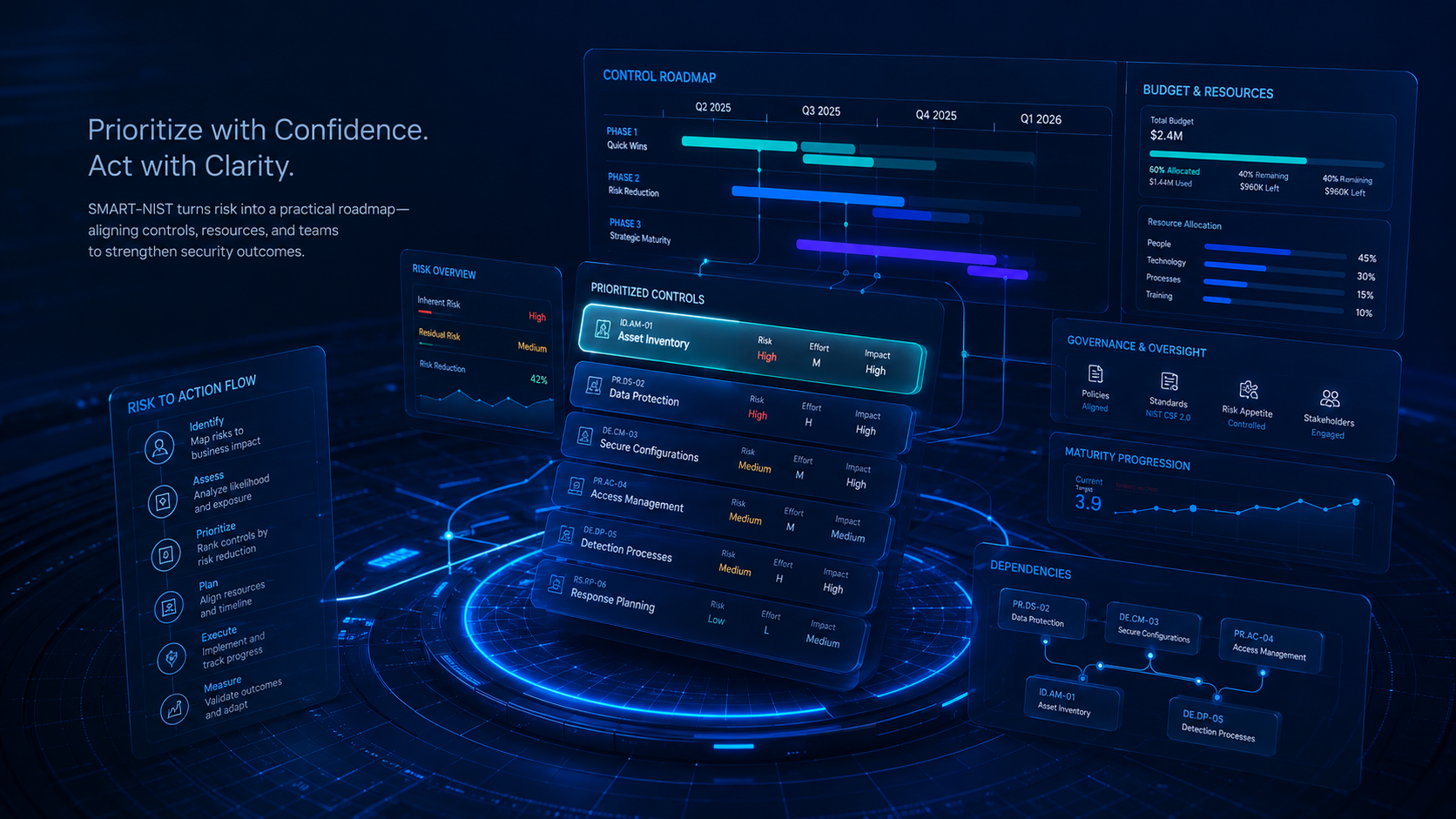
Governexis develops decision-support technology that helps organizations prioritize cybersecurity controls, align governance efforts, and plan risk-reduction investments with greater clarity.
Organizations face large cybersecurity control catalogs while budgets, staffing, maturity levels, and dependencies limit what can realistically be implemented. Governexis is building SMART-NIST to help decision-makers explain which controls should come first and why.
Connect cybersecurity priorities to leadership, policy, accountability, and defensible planning.
Support decisions based on risk-reduction value, organizational context, and practical constraints.
Help organizations think through cybersecurity investments within realistic financial limits.
Make roadmap reasoning easier to communicate to leaders, auditors, and operational teams.
SMART-NIST is being developed to support cybersecurity control prioritization under real-world constraints such as budget, maturity, dependencies, and implementation readiness. The goal is not to replace cybersecurity professionals, but to support better decision-making through structured, repeatable, and explainable planning.


Governexis was founded by Marco Hacker, a U.S. Navy veteran and cybersecurity doctoral student with experience in military administration, systems support, database administration, logistics, compliance documentation, and cybersecurity studies.
The company reflects a practical mission: helping organizations make smarter, clearer, and more defensible cybersecurity governance decisions without exposing internal patent strategy, formulas, or detailed optimization mechanics on the public website.
Governexis is positioning SMART-NIST for organizations that need practical, budget-aware cybersecurity planning, including small and mid-sized businesses, government contractors, healthcare organizations, education institutions, technology companies, and public-sector partners.
Turn complex control requirements into clearer phases and priorities.
Support framework-aware planning without claiming automatic compliance.